
On behalf of Michael Jeffreys and his family the SPBS is sorry to report that Elizabeth Jeffreys died painlessly early on the morning of 12.09.2023. She was recovering well after a stroke two months ago, but had to go back to hospital on Sunday.
The world of Byzantine studies has lost a great scholar and a wonderful friend who was an inspiration to us all.

Updated version of the 1st Circular, Vienna Congress
On behalf of Christos Stavrakos, Secretary of the AIEB (Association Internationale des Études Byzantines), please find below an updated version of the First Circular of the 25th International Congress of Byzantine Studies (Vienna 2026), including a language update.
_______
Dear Colleagues,
Following the online meeting of the Organizing Committee of the 25th International Congress of Byzantine Studies -Vienna 2026 with the members of the AIEB Bureau on 16 March 2023, we would like to inform you about the preliminary profile and structure of the Congress program and to appeal to all National Committees to send us their proposals for Round Tables by 31 December 2023. The call for Free Communications will be sent in spring 2025. You may find below the main theme of the Congress, the themes of six Plenary Sessions, as well as the timetable and procedures for Round Tables, to be confirmed and approved at the Inter Congress meeting in Athens on 12 April 2024.
INFORMATION ON THE PROFILE AND STRUCTURE OF THE 25th CONGRESS OF BYZANTINE STUDIES, Vienna 2026
Date: The 25th International Congress of Byzantine Studies will be held on 24 to 29 August 2026 in Vienna, Austria.
Main Theme: “Byzantium beyond Byzantium”, “Byzance au-delà de Byzance”, “Byzanz jenseits von Byzanz”, “Bisanzio oltre Bisanzio”, “Το Βυζάντιο πέρα από το Βυζάντιο”
General Rule: Scholars can participate in no more than two sessions throughout the Congress. (i.e., as speaker in two sessions, or as speaker in one session plus as convener, or as convener in two sessions).
Plenary Sessions: There will be six Plenary Sessions. The list of Plenary Session themes and speakers will be approved at the Inter-Congress meeting in Athens on 12 April 2024. National Committees will be informed about the details shortly before the meeting.
The themes for Plenary Sessions are:
1. Byzantium lost and found
2. Romanitas beyond Byzantium. Diffusion and impact of ideas of Rome in a „post-Roman” world
3. The beasts, the crops and the bones. Biological perspectives on the Byzantine world
4. Byzantine Diversities
5. Reading Byzantine literature across the centuries
6. Byzantium in Central Europe
Round Tables:
General rules
1. Round Tables must be proposed through the National Committee of the proposer. There is also the option of joint proposals by more than one National Committee.
2. Round Tables are allocated 90 minutes. They should consist of no fewer than four and no more than six speakers, plus the convener(s), in order to ensure adequate time for discussion.
3. The professional affiliation of the speakers should represent at least two countries. We particularly encourage the inclusion of young researchers.
4. We strongly encourage those who propose Round Tables to follow the Congress main theme.
5. The most important criterion for accepting a Round Table proposal will be its innovative scholarly contribution.
6. The number of proposals, including joint proposals by each National Committee is limited to ten.
7. Proposals should include a title, an abstract of 250 words, 5 key words, the names of the convener(s) and speakers as well as the name of the person sending the proposal, his/her affiliated institution and his/her mail address.
8. Proposals should be written in English, French, German, Italian, or Modern Greek.
Timetable
– The deadline for submission of Round Table proposals by National Committees to the Organizing Committee is 31 December 2023. Any Round Table proposal sent after the deadline will not be accepted. The proposals should be sent to program.ICBS2026@univie.ac.at.
– Conveners of Round Tables will be informed about the decision of the Program Committee (in accordance with the Bureau of the AIEB) in mid-February 2024. Proposed Round Tables will either be accepted or rejected or the option of an Organized Session will be offered.
– Conveners of accepted Round Tables will be asked to confirm their participation and the organisation of their Round Tables by 31 March 2024. – The list of Round Tables will be presented at the Inter-Congress meeting in Athens on 12 April 2024.
Vienna, March 2023
The Organizing Committee
THE INTERNATIONAL BYZANTINE GREEK SUMMER SCHOOL
THE INTERNATIONAL BYZANTINE GREEK SUMMER SCHOOL, hosted by Trinity College Dublin, is being held entirely online again this year, though we hope to offer at least some courses face-to-face in Dublin in 2024.
We are happy to confirm that the 2023 International Byzantine Greek Summer School will take place in the weeks of 17-28 July (Beginners) and 31 July-11 August (Intermediate and Advanced). All courses will run online in small groups led by experienced teachers. Each level comprises two weeks of full-time study, with two two-hour teaching sessions daily
Byzantine Greek is the dominant form of Greek written during the Byzantine Empire (AD 330–1453). The spoken language changed significantly in this period and came close to Modern Greek, but most Byzantine authors use conservative forms of Greek that looked back to Classical Attic, the Hellenistic Koine and Biblical Greek. Therefore much of the vocabulary, morphology and syntax of Byzantine Greek are not significantly different from Classical Greek, which makes this course a suitable preparation also for reading Classical literature and the New Testament.
The International Byzantine Greek Summer School (IBGSS), directed by Dr Anthony Hirst, moved to Dublin in 2016 after many years of success at Queen’s University Belfast (2002-11) and the University of Birmingham (2012-15). The course teaches Byzantine Greek at Beginners, Intermediate and Advanced level and allows early learners to engage with original texts from the start. Each level comprises two weeks of full-time study.
Although the original application deadline for 2023 was the 5th of May, it has been extended to the 31st of May (ten days from now). There are still a limited number of places available at all levels: Beginners, Intermediate, Higher Intermediate and Advanced Reading.
If you wish to apply go to www.tcd.ie/Classics/byzantine for details and the application form.
Funding applications, however, can no longer be accepted.
Robert Ousterhout
We are deeply saddened that Robert Ousterhout, Professor Emeritus of History of Art, University of Pennsylvania, and renowned expert on Byzantine architecture, died peacefully at home on Sunday 23 April 2023, surrounded by family. He was a good friend to the SPBS, spoke at several Spring Symposia, and will be much missed by many of us.
Recordings of SPBS lectures
Our collection of recordings has been updated with three further lectures from 2021-2:
- Re-thinking Late Antiquity as Early Christendom by Prof. Judith Herrin
- The Byzantine Empire and the Shape of Afro-Eurasia Today (and Tomorrow) by Dr Rebecca Darley
- Into the Labyrinth: A Journey into Stoudite “Cancel Culture” by Prof. Rosemary Morris
The 54th Spring Symposium of Byzantine Studies
The 54th Spring Symposium of Byzantine Studies
Material Religion in Byzantium and Beyond
17-19 March 2023, Corpus Christi College & All Souls College, Oxford
The 54th Annual Spring Symposium in Byzantine Studies will be held in Oxford on the theme of Material Religion in Byzantium and Beyond. The Symposium brings together Byzantine studies with a series of innovative approaches to the material nature and realities of religion – foregrounding the methodological, historical and archaeological problems of studying religion through visual and material culture. Taking a broad geographical and chronological view of the Byzantine world, the Symposium will range across Afro-Eurasia and from Antiquity to the period after the fall of Constantinople. Sessions will be arranged around the themes of ‘Objects in motion’, ‘Religion in 3D’, ‘Religious landscapes’, ‘Things without context’, ‘Things and their context’ and ‘Spatial approaches to religion’.
Confirmed speakers include: Béatrice Caseau, Paroma Chatterjee, Francesca Dell’Acqua, Ivan Foletti, David Frankfurter, Ildar Garipzanov, Troels M. Kristensen, Anne Lester, Birgit Meyer, Brigitte Pitarakis, Regula Schorta, Myrto Veikou, and Anne-Marie Yasin.
The Symposium will be hybrid, taking place at Oxford – Corpus Christi College and All Souls College –, and on Zoom.
Fees and registration:
– In person, for three days: Full: £130; Members of the SPBS: £110; Students/Unwaged: £60.
– In person, for one day: Full: £65; Members of the SPBS: £55; Students/Unwaged: £30.
– On-line: Full: £35; Members of the SPBS: £20; Students/Unwaged: £10
A booking form will soon be available online, on the Symposium website, with further details of registration and payment.
Symposiarchs
Jaś Elsner, Ine Jacobs, Julia Smith
SPBS ODA reduced membership rates
The SPBS is pleased to announce reduced membership rates for individuals who live, work, and permanently reside in 149 countries which are currently in receipt of support from the Office of Development Assistance.
The reduced membership rates are:
£10.00 per year for full membership
£5.00 per year for student membership
New members will receive the full benefits of SPBS membership and a PDF copy of the annual SPBS Bulletin.
For further information on how to apply, please see our membership page.
International Congress of Byzantine Studies Fund
The SPBS is pleased to announce that it is able to offer grants of up to £400 to support the attendance of UK postgraduate students and early career scholars at the International Congress of Byzantine Studies, Venice-Padua, 22-27 August 2022. The funding can be used to cover registration fees, as well as accommodation and travel costs.
Applicants are expected to be members of the SPBS at the time of application but are eligible for a reduced student membership rate.
Priority will be given to applicants who are currently unfunded and to those who are offering a communication.
The deadline for applications is Monday 27th June at 17:00 (UK).
For full details and application form can be found here.
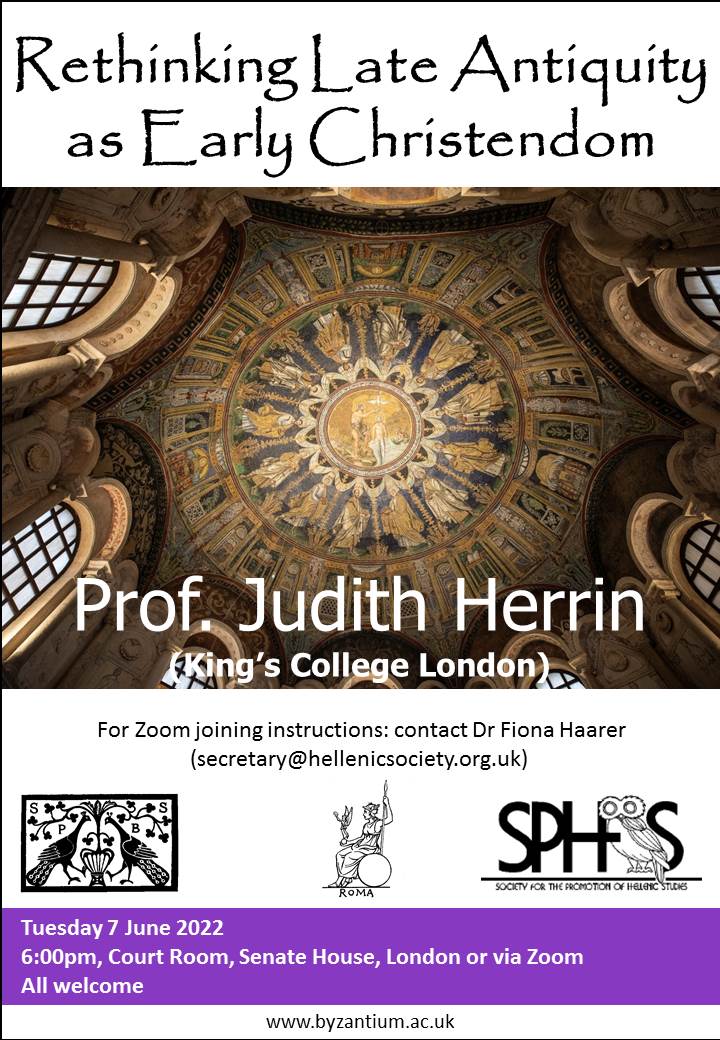
Rethinking Late Antiquity as Early Christendom
Court Room, Senate House, Malet Street, WC1E 7HU
7 June 2022, 18:00
The SPBS, in association with the Hellenic Society and the Roman Society is pleased to announce a public lecture by Professor Judith Herrin, ‘Rethinking Late Antiquity as Early Christendom’.
If you are unable to attend the lecture in person, it will be streamed via Zoom. Please email Dr Fiona Haarer for joining instructions.
The Byzantine Empire and the Shape of Afro-Eurasia Today (and Tomorrow)
24 May 2022, 17:00 (London) 18:00 (Vienna)
The joint SPBS and ÖBG lecture this year will be given by Dr Rebecca Darley, and presented via Zoom. All are welcome.
To register, please visit: https://www.eventbrite.co.uk/e/335734991397
