Stay Connected with the International Association of Byzantine Studies

The International Association of Byzantine Studies (AIEB) warmly invites scholars, students, and all those with an interest in Byzantium to connect with us through our official social media channels. By following our accounts, you will receive updates on the Congress and remain informed about the broader initiatives, announcements, and scholarly developments associated with the AIEB.

We welcome you to follow us on:

Facebook – International Association of Byzantine Studies (AIEB)

Instagram – @aieb_byzantium

BlueSky – aieb-byzantium.bsky.social

♱ John Lowden ♱ (1953-2026)

It is with great sadness that we announce that John Lowden, Professor of Art History at the Courtauld Institute of Art, University of London and Fellow of the British Academy, died peacefully on Tuesday, 27 January 2026, with his wife Joanna Cannon and son Gregory at his bedside. John had been diagnosed with Parkinson’s Disease many years earlier.

John studied for his MA and PhD at the Courtauld and joined its academic staff in 1982 after a brief period teaching at St Andrews. He taught generations of students there until his retirement in 2017. Byzantinists will know him especially for his many works on Byzantine manuscripts, including Illuminated Prophet Books (1998),  The Octateuchs (1992) and the Jaharis Gospel Lectionary(2009), as well as his invaluable survey text Early Christian and Byzantine Art(1997). These all conveyed John’s deep and close understanding of medieval books, how they were made and how they were read. However, his intellectual reach was much broader. He set up the International Gothic Ivories Project (http://www.gothicivories.courtauld.ac.uk/) published an award-winning two-volume work on the Bibles Moralisées, and was a co-investigator of the Royal manuscripts in the British Library (leading to a major exhibition in 2012). That is only a small taste of his output.

John was far more than his research: he will be remembered by many as a generous and joyous colleague, an inspiring teacher and a great friend to many. His sense of humour and his pithy comments and questions in seminars were infectious, but also kept you on your toes. John’s own students – of whom there are many – will no doubt produce fuller and more insightful memories in the days and weeks to come.

John always ended the annual medieval postgraduate colloquium at the Courtauld by reminding everyone of what an auspicious day it was; so it seems only fitting to end by noting that John died on the Feast of the Return of the Relics of St John Chrysostom to Constantinople, when we also commemorate the memory of the Venerable Peter of Alexandria, Marciana wife of Justin I, Ashot Kuropalates of Georgia, St Devota of Corsica and many, many others. John is in excellent company, but he will be greatly missed by all of us who remain behind.

Antony Eastmond

Byzantium and Bloomsbury: A one-day online workshop, 1 April 2026, 10am-5pm, organised by The Society for the Promotion of Byzantine Studies

This one-day online workshop, organized by Liz James, Rowena Loverance, and Shaun Tougher, will focus on the interest of members of the Bloomsbury Group in Byzantium, especially Byzantine art. Both Vanessa Bell and Duncan Grant demonstrated an interest in Byzantine art, in terms of their aesthetic concerns and their subject matter; in 1912 Vanessa Bell painted a work entitled ‘Byzantine Lady’ and Grant painted a similar work entitled ‘The Countess’, and their Famous Women dinner service, commissioned by Kenneth Clark in 1932, featured the Empress Theodora as one of the twelve queens depicted on the set of fifty plates. However, the Bloomsbury Group’s interest in Byzantine art was more profound than this. Byzantium had a vital place in Clive Bell’s Art (1914); Clive, art critic and husband of Vanessa, declared ‘since the Byzantine primitives set their mosaics at Ravenna, no artist in Europe has created forms of greater significance unless it be Cézanne’. His enthusiasm was shared by Roger Fry, both artist and art critic (and collaborator with Vanessa and Duncan in the Omega Workshop, 1913-1919), who initially labelled Cézanne and Gauguin as ‘proto-Byzantines’ before adopting the term ‘post-Impressionists’. Boris Anrep, who worked in mosaic (e.g. at Westminster Cathedral), knew Fry (Anrep’s wife left him for Fry), Lytton Strachey, Maynard Keynes and Virginia Woolf.

In recent years, there has been a growing interest in the work of Vanessa Bell, Duncan Grant and Roger Fry. In October 2024 there was an exhibition at the MK Gallery on Vanessa Bell, A World of Form and Colour, Charleston (Vanessa and Duncan’s Sussex home) has recently opened an exhibition devoted to Roger Fry (15 November 2025 – 15 March 2026), and in 2026 there will a major exhibition at Tate Britain on Bell and Grant (12 November 2026 – 11 April 2027). Thus, this is an opportune moment to turn the spotlight on the interest of the Bloomsbury Group in Byzantium.

The workshop will feature a series of talks by scholars, as well as discussion sessions. Contributors include:

  • Elizabeth Berkowitz, “A Modern-made Byzantium”?
  • Niamh Bhalla, More than a Method? Boris Anrep’s St Patrick Mosaic at Mullingar and the Dialectics of Universalism, Continuity and Irish Particularity
  • Rowena Loverance, “Degraded and conventional” or “awfully swell”? Roger Fry’s Use and Abuse of Byzantine Art
  • Chris Reed, Byzantium in/as Modern Art; or, How to Avoid “A Nasty Wooly Realism about the Sheep”
  • Jane Williams, “A breath in the modern world.” Boris Anrep’s Mosaics: A Russian Contribution to the Enthusiasm for Byzantium

The workshop is open to members of the Society for the Promotion of Byzantine Studies (reduced fee), but also to non-members (full fee). The reduced fees also apply to members of the British School at Athens. To find out more about how to enroll or contact details, please click here.

Society for the Promotion of Byzantine Studies / British School at Athens Autumn Joint Lecture with Dr Vicky Manolopoulou

Dr Vicky Manolopoulou (Ca’ Foscari University of Venice), “A Landscape of Fear and Hope: Perceptions and Responses to Environmental change in Byzantine Constantinople”

4 December @ 4:00 pm – 5:00 pm GMT

How did the environment shape landscape experience in Byzantine Constantinople? This talk explores aspects of the environmental history of the city by focusing on environmental emotion; it discusses how the city’s inhabitants experienced, imagined, and emotionally adapted to a changing environment shaped by earthquakes, storms, and other challenging climatic conditions. Drawing together newly available high-resolution paleoclimatic data from the Uzuntarla speleothem record with textual and archaeological evidence, the paper uncovers how Constantinople’s citizens transformed fear and uncertainty into narratives of hope, resilience, and divine protection. Moving between the concepts of “landscapes of fear” and “landscapes of hope,” it illuminates the affective dimensions of urban life in the Byzantine world and the multifaceted relationship between people and place.

To attend online via webinar, please register HERE

LocationLecture Theatre 2.16, 2nd Floor, Armstrong Building (University map ref:22), Newcastle University

PRAYER IN LATE ANTIQUITY

12th Nordic Patristics Meeting 20–22 August 2026, University of Helsinki (Finland)

We are pleased to invite proposals for the 12th Nordic Patristics Meeting on “Prayer in Late Antiquity”, which will be held 20-22 August 2026 at the University of Helsinki (Finland). The meeting aims to explore the theme of prayer in late antiquity, both as a religious practice, the subject and medium of theological thought, and a socio-religious identity marker. We invite contributions, e.g., on the evolving concept and practice of prayer, its theological foundations, its everyday performance, and/or its role in defining religious communities and identities during the transformative period of late antiquity.

At the date of publication of this call, the following keynote speakers have confirmed their attendance:

Anni Maria Laato (Åbo/Turku), Barbara Crostini (Uppsala), Maria Munkholt Christensen (Bonn), Harald Buchinger (Regensburg), and Bishop Damaskinos (Olkinuora) of Haapsalu.

We welcome submissions for 20-mins. presentations that address one of the following three broad themes:

1. THEOLOGIES OF PRAYER

How was prayer conceptualised and theorised in Christian, Jewish, and Graeco-Roman thought? How did theologians engage with specific prayers, such as the Lord’s Prayer? And how was prayer shaped by the languages of late antique religions? Possible topics in this section include:

Theologies and Prayer: The nature of prayer and its theological underpinnings in Christianity, Judaism, and Graeco-Roman thought.

Functions of prayer, e.g., conversations with God, intercession, or meditation.

Goals of prayer, such as deification, transcendence, or mystical union.

Exegetical and doctrinal discussions on prayer found in patristic, rabbinic, and philosophical texts.

2. PRACTICES OF PRAYER

This section focuses on the tangible and performative aspects of prayer in late antiquity. We encourage contributions that examine:

How prayer was ritualized and performed across different religious contexts.

Intentions of prayer and their impact on practices.

Bodily gestures, posture, and voice in prayer practices.

The significance of sacred spaces, times, and objects in the performance of prayer.

The interplay between personal and communal prayer, including liturgical and spontaneous forms of devotion.

13. PRAYER IN PRACTICE

This theme addresses the lived experience of prayer, highlighting how prayer functioned in shaping social identities, communal boundaries, and spiritual lives. Potential areas of focus include:

Roles of prayer in monasticism: ascetic practices, and personal spirituality.

Prayer as a tool for constructing religious identity and negotiating social conflicts.

The connection between prayer and broader socio-religious changes, such as the decline of sacrifices or the rise of Christian liturgies.

The impact of prayer on daily life, from silent prayer to public liturgical practices.

We encourage submissions from all interested disciplines, and particularly welcome interdisciplinary approaches that explore prayer as both a theological concept and a lived practice.

Submission Guidelines

Please submit an abstract of no more than 250 words by 15 November 2025, clearly indicating which

section or sections of the conference your contribution will primarily address primarily. Include your name, institutional affiliation, and contact information.

Please send your abstract to the secretary of the Societas Patristica Fennica, Mr. Tomi Ferm, at sihteeri@suomenpatristinenseura.fi

For any inquiries related to this call for papers, please contact Dr. Harri Huovinen (University of Eastern Finland) at harri.huovinen@uef.fi

The programme committee for the 12th Nordic Patristics Meeting: Harri Huovinen (University of Eastern Finland), Tomi Ferm (University of Helsinki), Ella Sahivirta (University of Helsinki), Panagiotis Pavlos (University of Oslo), Katarina Pålsson (Lund University), Florian Wöller (University of Copenhagen)

Mary B. Cunningham

It is with great sadness that the Society for the Promotion of Byzantine Studies (SPBS) announces the death on 11 October 2025 of our dear friend and colleague Dr Mary B. Cunningham, Vice-President of the Society and Honorary Associate Professor in the Department of Theology and Religious Studies at the University of Nottingham, UK.

Mary was a distinguished scholar and a valued member of our community, whose contributions to Byzantine studies and to the Society will be remembered with deep respect and gratitude.

Save the date! Byzantium and Bloomsbury

A one-day online workshop, 1 April 2026, 10am-5pm, organised by The Society for the Promotion of Byzantine Studies

This one-day online workshop will focus on the interest of members of the Bloomsbury Group in Byzantium, especially Byzantine art. Both Vanessa Bell and Duncan Grant demonstrated an interest in Byzantine art, in terms of their aesthetic concerns and their subject matter; in 1912 Vanessa Bell painted a work entitled ‘Byzantine Lady’ and Grant painted a similar work entitled ‘The Countess’, and their Famous Women dinner service, commissioned by Kenneth Clark in 1932, featured the Empress Theodora as one of the twelve queens depicted on the set of fifty plates. But the interest of the Bloomsbury Group in Byzantine art was more fundamental than this. Byzantium had a vital place in Clive Bell’s Art(1914); Clive, art critic and husband of Vanessa, declared ‘since the Byzantine primitives set their mosaics at Ravenna no artist in Europe has created forms of greater significance unless it be Cézanne’. His enthusiasm was shared by Roger Fry, both artist and art critic (and collaborator with Vanessa and Duncan in the Omega Workshop, 1913-1919), who initially labelled Cézanne and Gauguin as ‘proto-Byzantines’ before adopting the term ‘post-Impressionists’. Boris Anrep, who worked in mosaic (e.g. at Westminster Cathedral), knew Fry (Anrep’s wife left him for Fry), Lytton Strachey, Maynard Keynes and Virginia Woolf.

In recent years there has been a growing interest in the work of Vanessa Bell, Duncan Grant and Roger Fry. In October 2024 there was an exhibition at the MK Gallery on Vanessa Bell, A World of Form and Colour, this year Charleston (Vanessa and Duncan’s Sussex home) will mount an exhibition devoted to Roger Fry (15 November 2025 – 15 March 2026), and in 2026 there will a major exhibition at Tate Britain on Bell and Grant (12 November 2026 – 11 April 2027). Thus this is an opportune moment to turn the spotlight on the interest of the Bloomsbury Group in Byzantium.

The workshop will feature a series of talks by scholars (including Professor Christopher Reed, author of Bloomsbury Rooms), and will also include discussion sessions. It is open to members of the Society for the Promotion of Byzantine Studies (reduced fee), but also to non-members (full fee). It is organised by Liz James, Rowena Loverance and Shaun Tougher. Further details will be released in due course. For expressions of interest/initial queries please contact Shaun Tougher (toughersf@cardiff.ac.uk).

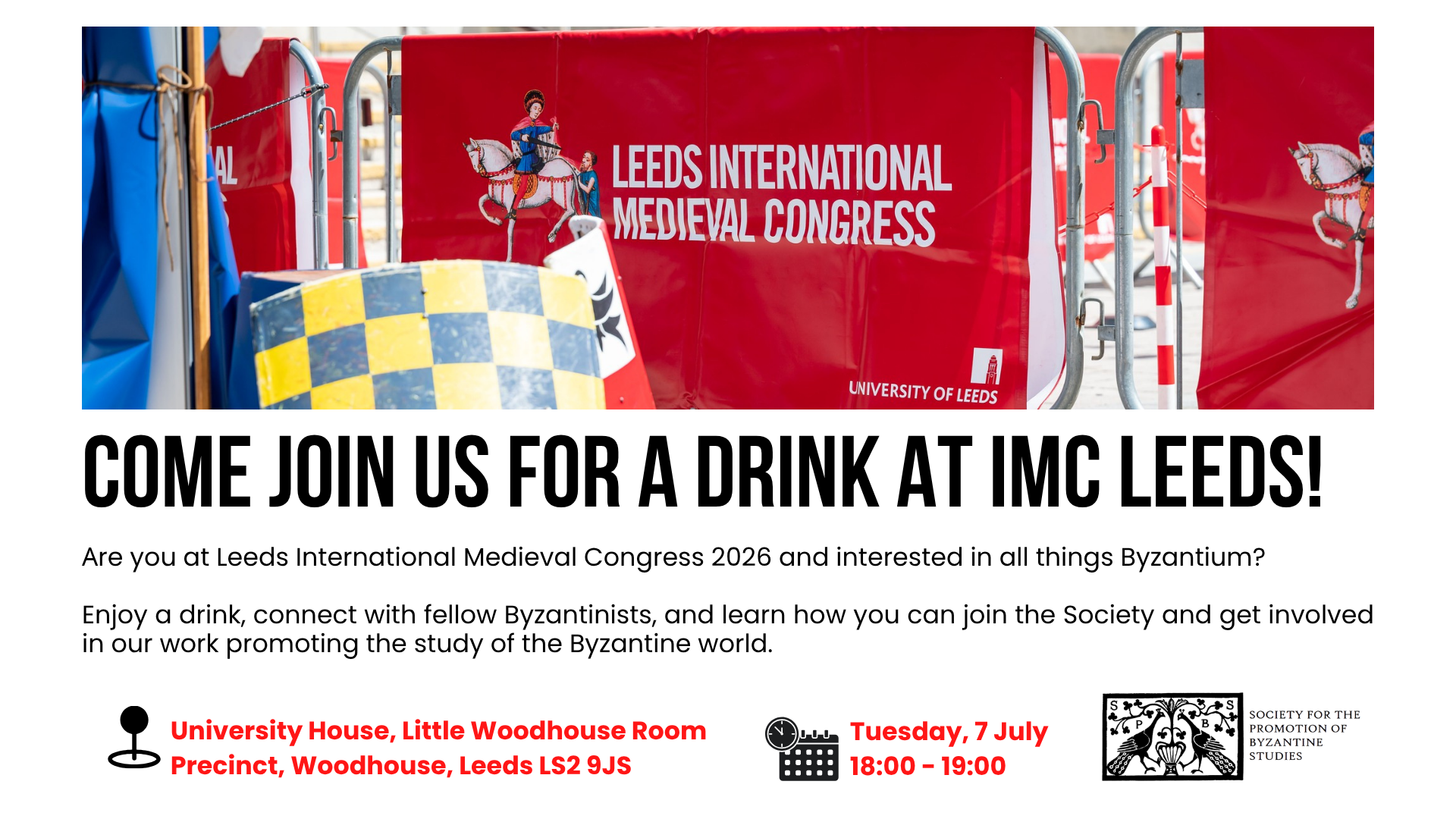
SPBS Reception at the International Medieval Congress, Leeds – Tuesday 8 July

The Society for the Promotion of Byzantine Studies is pleased to announce that it will be hosting a drinks reception at the International Medieval Congress 2025, held at the University of Leeds.

Date: Tuesday, 8 July 2025
Time: 18:00–19:00
Venue: University House, Little Woodhouse Room, University of Leeds
We warmly invite all registered attendees of the Congress with an interest in Byzantine studies to join us for this informal gathering. The reception offers an excellent opportunity to meet fellow Byzantinists, engage in conversation, and learn more about the Society’s work in promoting the study of Byzantium.

Whether you are a long-standing member or new to the field, we would be delighted to welcome you.

For further information about the Society and its activities, please explore the rest of our website or get in touch via our contact page.

John H. Pryor

It is with great sadness that we pass on the news that John H. Pryor, Emeritus Professor of Medieval History at Sydney University, passed away early on Tuesday March 24th. Professor Pryor’s son Sean has indicated that although his father’s death was somewhat sudden, he had been unwell for a long time. Nonetheless, John Pryor had been down at the family’s holiday house south of Sydney until the morning before he died and had walked out along his favourite beach a few days earlier. Characteristically, he had asked not to have a funeral or memorial service.


Professor Pryor will be very well known to many scholarly audiences for his pathbreaking scholarship which brought together the study of the western Middle Ages, the Islamic world, the Crusades and Byzantium. The focus of his research was on maritime history, particularly in the Mediterranean. Author of multiple publications which combined analyses of the practicalities of sea-faring, trade and naval warfare, his most notable book was Geography, Technology, and War: Studies in the Maritime History of the Mediterranean, 649-1571 (Cambridge, 1988), a widely reviewed volume which was regarded  as soon as it appeared as a landmark publication. Integral to JP’s analysis was his identification of the fundamental significance of the counterclockwise current in the Mediterranean for shipping, trade and conflict across the medieval centuries. Professor Pryor was notable for his focus on Byzantium as a central component of a complex Mediterranean world, with his collaboration with the late Professor Elizabeth Jeffreys leading to another landmark publication The Age of the Dromon: The Byzantine Navy ca. 500-1204 (Leiden: Brill, 2006). He was a regular participant in Byzantine conferences including the Spring Symposium. And he was still publishing important articles and book chapters into the 2020s. An index of the significance of JP’s scholarship was the 2016 Festschrift, Shipping, Trade and Crusade in the Medieval Mediterranean, published by Routledge, which ran to more than 400 pages and included contributions from twenty of the most significant scholars in the many fields on which he had made such a profound impact. His students will remember him as an extraordinarily generous, stimulating and intellectually rigorous teacher, whose enjoyably sardonic humour came with great warmth.


Catherine Holmes, Amanda Power